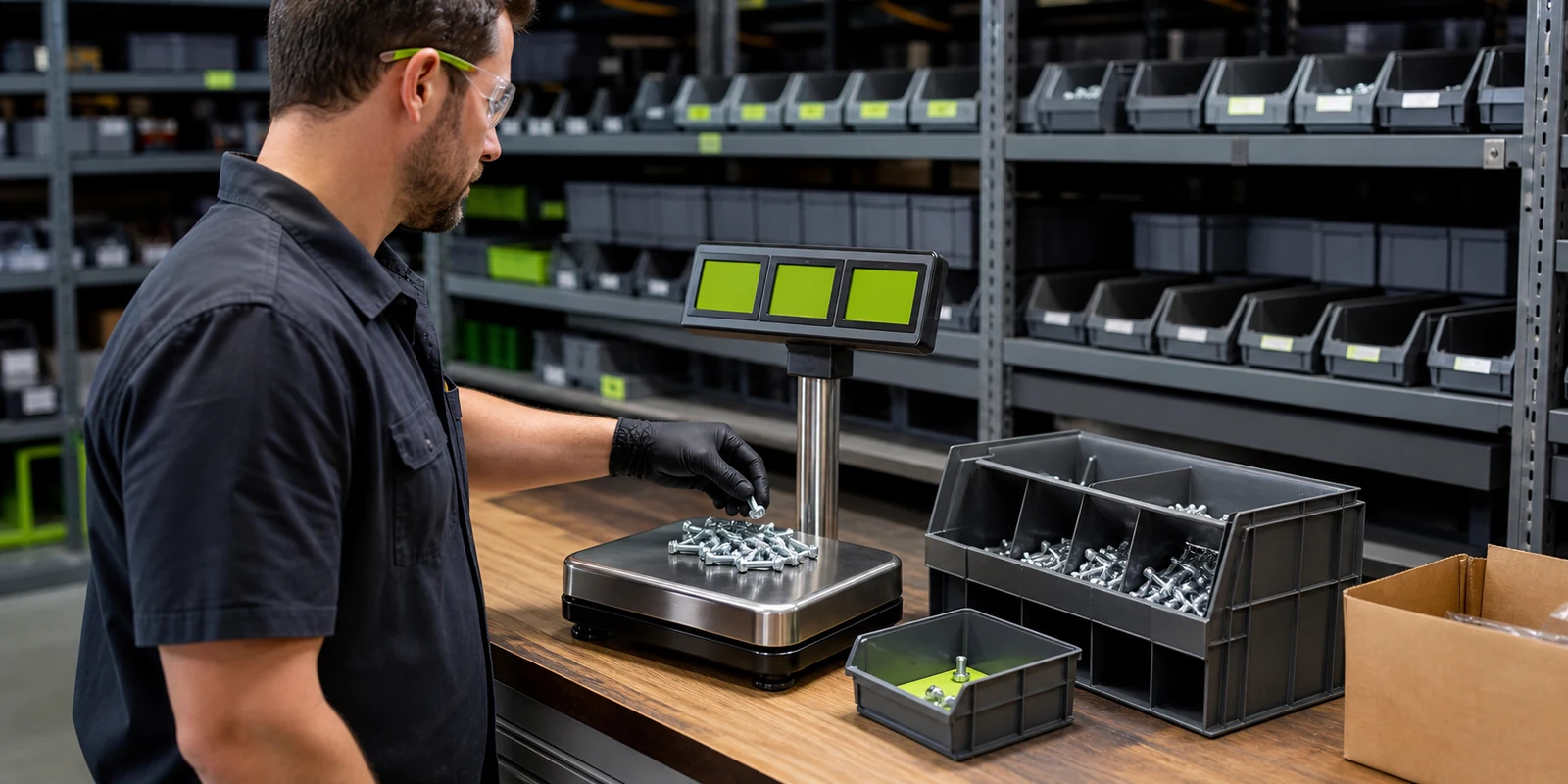
How counting scales work
A counting scale starts with one simple idea: if the scale knows the average weight of one item, it can estimate how many matching items are on the platform. The operator places a known sample on the scale, enters the sample quantity, and the scale calculates the average piece weight.
Once that average is stored, the scale divides the total net weight by the average piece weight. This gives a fast piece count for screws, caps, fittings, labels, components and many other warehouse items.
Step-by-step counting process
Tare the empty container so only the parts are counted. Add a known sample quantity such as 10, 20 or 50 pieces. Enter the sample count and wait for the scale to calculate the average. Add the remaining stock and read the quantity.
For light items, use a larger sample. A bigger sample improves the average and reduces counting error.
Warehouse tips
Keep batches separate when piece weights differ. Place the scale on a stable bench. Avoid fans, vibration and mixed items. Re-sample when changing suppliers or materials. Use check-counting alarms for packing and picking jobs.
Quick checklist
- Use a large enough sample size.
- Tare bins and cartons every time.
- Keep mixed parts separate.
- Wait for a stable reading.
- Re-sample when batch weight changes.
Frequently asked questions
Can counting scales count very small parts?
Yes, if the scale readability is suitable and the sample size is large enough.
Why does the count change between batches?
Different suppliers, materials or manufacturing tolerances can change average piece weight.
Do counting scales need calibration?
Yes. Weight accuracy directly affects count accuracy.
Need help choosing the right weighing setup?
Richter Scale can help match the scale, load cell, indicator, calibration plan or software integration to your application.
Contact Richter ScaleBack to news articles